
Yes, Monaco is a sovereign country
Monaco is an independent and sovereign country, officially named the Principality of Monaco. France recognised its independence in the Franco-Monegasque Treaty of 1861, and the country holds a seat at the United Nations since 1993. Monaco has its own Prince, its own government, its own laws, its own courts and its own nationality.
The doubt comes from the setting. Monaco sits on the French Riviera, shares its only land border with France, uses the euro and appears on maps as a dot next to Nice. Yet none of these links removes its sovereignty: they come from agreements between two states, signed freely and revised over time.
How Monaco meets the legal criteria of a state
In international law, the Montevideo Convention of 1933 sets out four criteria that define a state. Monaco meets each of them, despite its size.
The size of a territory plays no role in this definition. Vatican City, San Marino or Liechtenstein follow the same logic: small surface, full sovereignty. What counts is the exercise of authority over a territory and the recognition by other states, and Monaco has both. More than 160 countries maintain diplomatic relations with the Principality, and its diplomats sit in the same assemblies as those of larger nations.
Monaco's relationship with France
The confusion around Monaco's status comes from its close ties with France. The Principality shares its only land border with France, uses the euro and relies on France for its defence. Yet these links rest on treaties between two sovereign states, not on any form of dependence, and each treaty reflects a negotiated balance of interests.
The treaties that frame the relationship
- 1861, Franco-Monegasque Treaty: France recognises Monaco's independence. In exchange, Monaco gives up Menton and Roquebrune, which represented the major part of its territory at the time.
- 1918, Treaty of Protective Friendship: France commits to defend Monaco's independence, while Monaco agrees to align its policy with French interests.
- 1963, Franco-Monegasque tax convention: French nationals living in Monaco remain subject to French income tax, an exception still in force.
- 2002, Treaty of Friendship and Cooperation: this text replaces the 1918 treaty and confirms the sovereign equality of both countries. It also guarantees the continuity of the Principality, with or without a direct heir.
The 2002 treaty changed a point of daily politics: the Minister of State, who leads the Government, no longer needs French nationality. The Prince appoints the Minister, who is a French or Monegasque citizen, from a list proposed by the French government.
What France handles and what Monaco decides ?
A constitutional monarchy led by the Grimaldi family
The Sovereign Prince and the Government
The Grimaldi family has ruled Monaco since 1297, when François Grimaldi seized the fortress on the Rock. Monaco adopted its first Constitution in 1911, and the current text dates from 17 December 1962. It establishes a hereditary constitutional monarchy and the separation of powers.
Prince Albert II has reigned since 2005, after his father Prince Rainier III. The Prince exercises executive power through the Government, led by the Minister of State. Since July 2025, this role belongs to Christophe Mirmand, a former French prefect appointed by the Prince. The Government includes Councillors in charge of finance and the economy, the interior, social affairs and health, public works and external relations, each running a department of the Principality.
The National Council
The National Council forms Monaco's parliament. Its 24 members are elected every five years by Monegasque nationals. The Council votes laws and the state budget, which gives it a real counterweight to the executive. Only Monegasque citizens vote and stand in these elections, although foreign residents represent around three quarters of the population.
Monaco on the international stage
- United Nations: member since 28 May 1993, with full voting rights
- Council of Europe: member since 5 October 2004
- OSCE: participating state
- European Union: not a member, but linked through specific agreements; negotiations on closer access to the single market began in 2015 with Andorra and San Marino
- Euro: legal tender since 2002, under a monetary agreement with the EU
- Schengen area: not a formal member, but integrated through France, with no border checks
- Olympic Games: Monaco competes under its own flag
- National symbols: its own flag, national anthem, stamps, .mc internet domain and +377 dialling code
These elements give Monaco a recognisable identity abroad. The Principality plays an active role in areas such as ocean protection, sport and humanitarian causes, led by the Prince Albert II of Monaco Foundation and by the Oceanographic Institute founded by Prince Albert I.
Monaco, Monte-Carlo and the city-state question
Monaco is a city-state: the country and its capital share the same territory. There is no separate « city of Monaco » inside a larger country, and the government, the courts and the Palace all sit within the same few square kilometres.
Monte-Carlo forms one of the wards of the Principality, home to the Casino, the Hôtel de Paris and the Carré d'Or. It is neither a separate city nor the capital. Monaco-Ville, on the Rock, holds the historic centre with the Prince's Palace, the cathedral and the government buildings. Many people say « Monte-Carlo » for the whole country because of the Casino, the tennis tournament and the Rallye, which creates a lasting mix-up.
To see how these areas differ, read our guide Monaco vs Monte-Carlo and our overview of the districts of Monaco.
What Monaco's status means if you plan to live or invest there
Monaco's sovereignty has direct consequences for anyone who settles or buys property in the Principality. Rules come from Monegasque law, not French law, and each topic follows a specific procedure.
- Residency: Monaco issues its own residence card through the Sûreté Publique, based on proof of accommodation and financial resources; follow our guide to become a resident in Monaco
- Taxation: residents pay no personal income tax, with the exception of French nationals under the 1963 convention; read our guide on Monaco wealth tax
- Property purchase: each sale follows Monegasque property law and closes before a Monegasque notary; discover the role of notaries in Monaco, the Monaco property laws and whether foreigners can buy property in Monaco
- Leases: rentals follow a specific Monegasque framework, distinct from French rental law
- Nationality: living in Monaco gives no automatic right to Monegasque nationality, which passes mainly through filiation
These rules explain why a purchase in Monaco differs from a purchase in a French town a few minutes away, even with the same sea view. Taxes, formalities and ownership structures follow another logic, and a clear explanation at the start of the project avoids surprises later.
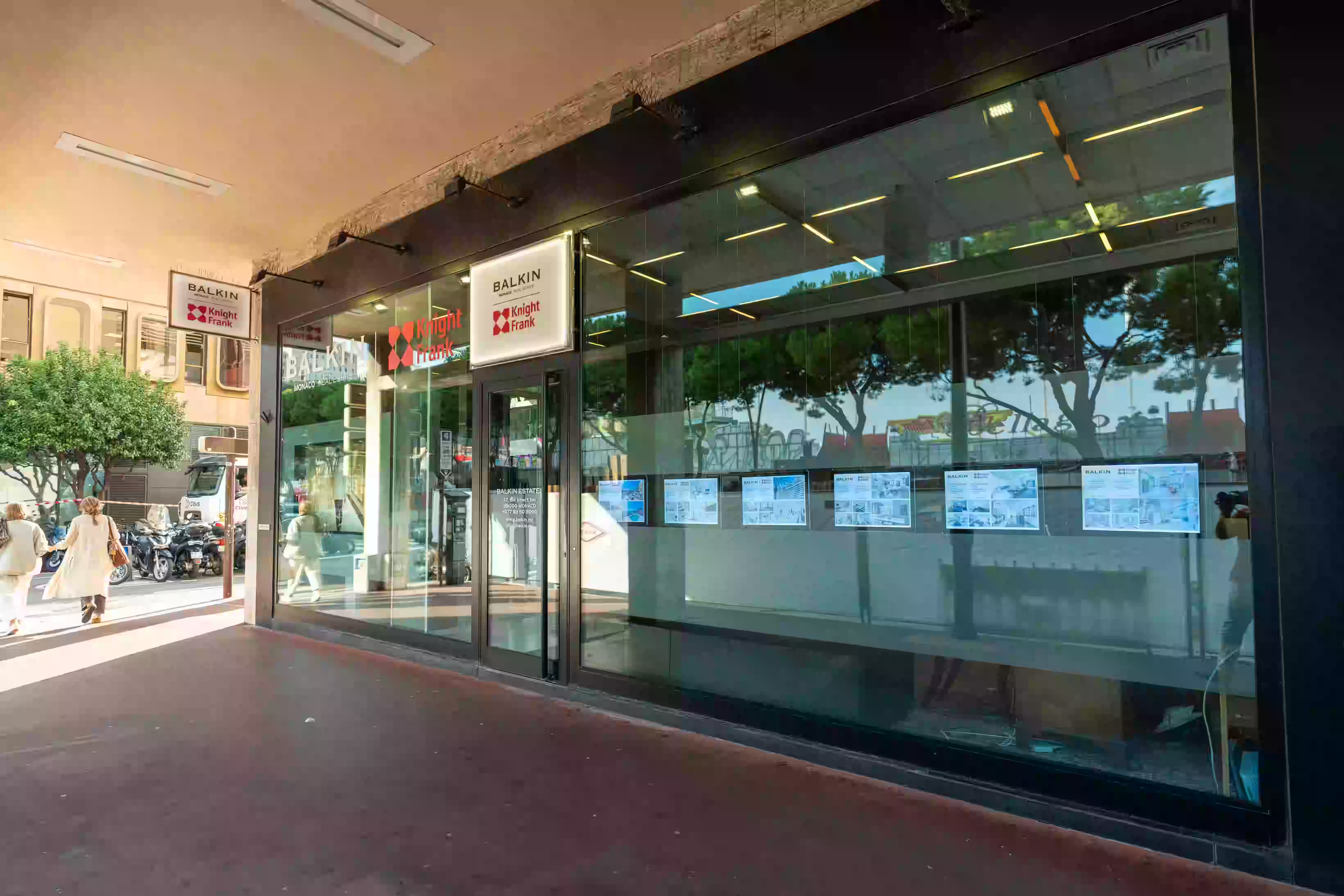
At Balkin, our team has guided international clients through these rules since 2005, with the support of our Legal Advisor and the Knight Frank global network. If you consider a move or an investment in the Principality, arrange a private consultation or read our guide to buying a second home in Monaco.

.avif)