
How Many Districts Monaco Really Has ?
Sources on Monaco's districts give different counts, ranging from seven to eleven, and the reason is a distinction rarely made explicit in most guides available online. Monaco's official administrative structure organises the territory into wards, defined by the government for civic and administrative purposes.
The real estate market, meanwhile, groups properties into districts defined by usage and reputation, which sometimes split or merge official wards to match how buyers and residents actually refer to areas such as the Carré d'Or or Saint Roman, neither of which exists as a formal administrative unit in its own right.
This guide follows the property-market grouping, since it matches the terms used when searching for, or discussing, an apartment in the Principality.
Monaco's Districts at a Glance : Character, Price Level and Typical Buyer
Monte-Carlo and the Carré d'Or
Monte-Carlo forms the district in the centre of the Principality, home to the highest concentration of Monaco's landmark addresses. Life here runs around the Place du Casino, with couture boutiques, Michelin-starred restaurants and grand hotels within walking distance of most residential buildings in the district, giving the area a density of amenities unmatched anywhere else in Monaco.
Inside the Carré d'Or
The Carré d'Or, the "golden square", sits at the heart of Monte-Carlo around the Casino de Monte-Carlo and the Hôtel de Paris. Property here trades at the top of the Principality's price range, reflecting the concentration of prestige addresses, direct access to luxury retail, and buildings maintained to the standard expected by an international clientele accustomed to comparable service levels in cities such as London or Geneva.
Boulevard des Moulins and Wider Monte-Carlo
Beyond the Carré d'Or itself, the wider Monte-Carlo district extends along Boulevard des Moulins and neighbouring streets, offering a mix of established bourgeois buildings and newer developments. Prices here sit below the immediate casino square while remaining among the highest in the Principality, making this stretch a common compromise for buyers who want the district's prestige without stretching to Carré d'Or pricing.
Landmark Residences
Buildings such as One Monte-Carlo, Le Mirabeau and Park Palace anchor the district's reputation, combining concierge services, security and interior standards set by leading architects and designers, and these addresses regularly command premium prices even relative to their immediate surroundings.
Larvotto and the Beachfront
Larvotto stands as Monaco's beach district, built along the promenade with direct access to the sand and to beach clubs. Residences such as Bay House, Palais de la Plage and Tour Odéon front the coastline, with proximity to the Grimaldi Forum, the convention and cultural centre that draws large numbers of visitors each year. Buyers here prioritise sea views and a walkable, resort-style daily life over the density of Monte-Carlo, and the district has seen consistent development activity in recent years, adding to its newer building stock.
Mareterra, the Principality's Newest District
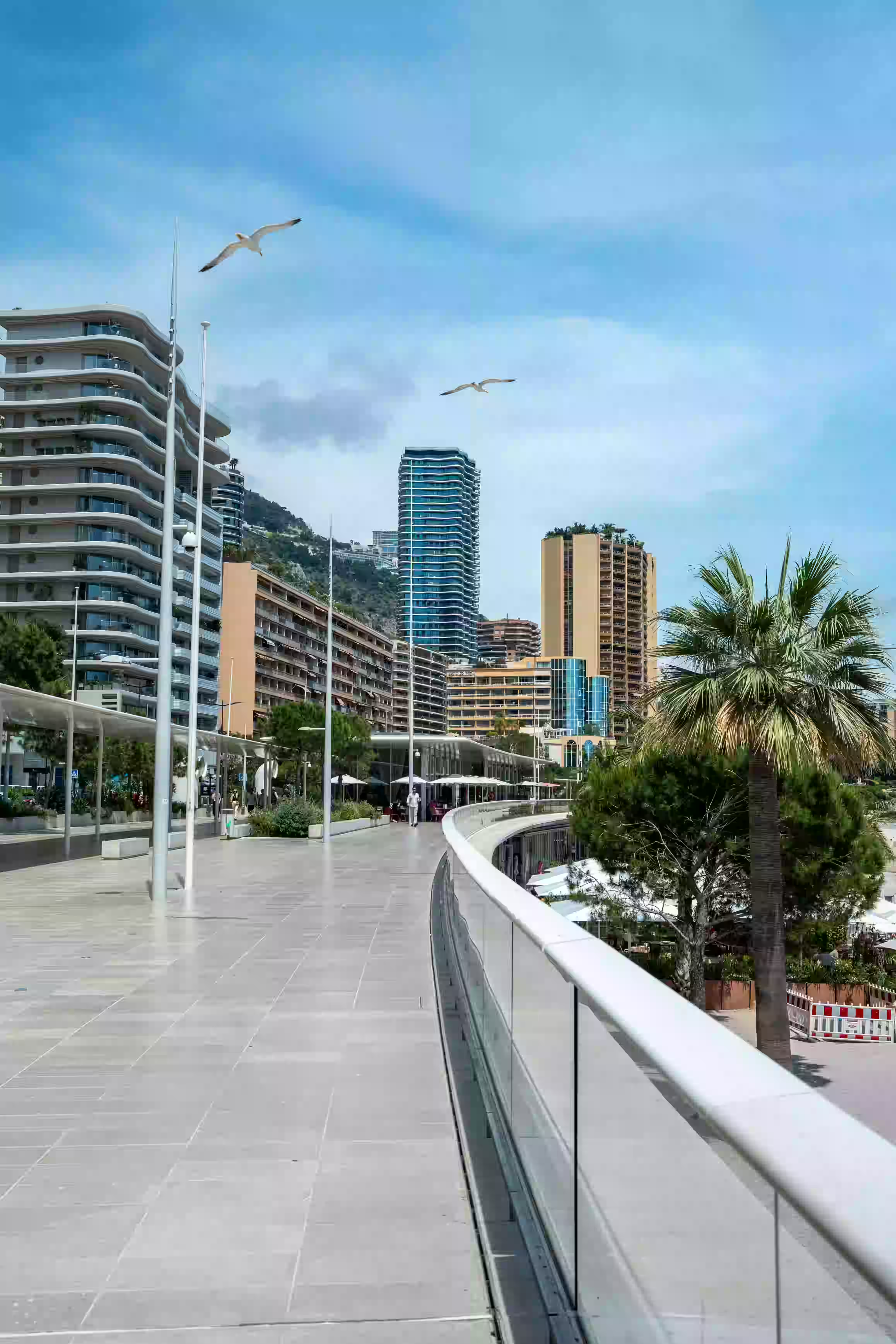
Mareterra is Monaco's land extension into the sea, inaugurated at the end of 2024, adding new residential surface to a territory where available land otherwise stays fixed at just over two square kilometres. The district brings contemporary architecture, landscaped gardens and a continuous seafront promenade, with apartments and villas released to the market in phases. Its recent completion means the district carries limited transaction history, which affects how price comparisons against established districts get made, and buyers considering Mareterra benefit from treating it as a distinct category rather than measuring it strictly against Larvotto or Monte-Carlo pricing.
La Rousse and Saint Roman
Located in the northern part of the Principality, near the border with France, La Rousse and Saint Roman form a residential district known for high-rise towers such as Tour Odéon, one of the tallest buildings in Monaco, alongside residences including the Mona and Bay House. The area sits close to the Monte-Carlo Country Club, host to the Rolex Monte-Carlo Masters tennis tournament, and offers larger apartment surfaces than the central districts, appealing to buyers who prioritise interior space and a quieter setting over walkability to the casino square.
La Condamine and Port Hercule
La Condamine ranks among Monaco's oldest districts, built between Port Hercule and Le Rocher. Daily life here runs through the open-air market on Place d'Armes, the pedestrian streets around Rue Princesse Caroline, and the quays lined with restaurants and bars, giving the district a genuinely local character rarely found elsewhere in the Principality. Buildings such as Palais Héraclès and the Bristol overlook the Monaco Grand Prix circuit directly, a point that draws specific attention from buyers interested in the race weekend, since a handful of units offer a direct view over the track itself.
Fontvieille
Fontvieille sits on land reclaimed from the sea in the 1970s, home to the Stade Louis II, the heliport, a shopping centre and Monaco's second marina. Residences here, including Terrasses du Port and Seaside Plaza, tend to offer larger surfaces and concierge amenities at a price per square metre below the central districts. Families favour the area for its parking availability, green spaces and calmer daily rhythm compared to Monte-Carlo, and the district also functions as something of an economic hub, hosting a number of the Principality's business offices.
Jardin Exotique, Les Révoires and Moneghetti
Positioned at the western edge of the Principality, Jardin Exotique occupies an elevated position with views over the coastline and the Palace. The district takes its name from the botanical gardens and includes the Princess Grace Hospital and the Moneghetti shopping area nearby. Buildings such as the Ligures and the Patio Palace offer panoramic outlooks, and the district ranks among the more accessible entry points to the Monaco market in terms of price per square metre, while remaining only a short distance from the centre thanks to the public transport network described below.
Monaco-Ville, Le Rocher
Monaco-Ville, known as Le Rocher, occupies the promontory that gives the Principality its historic silhouette. The district houses the Prince's Palace, the Cathedral, government buildings and the Oceanographic Museum, alongside narrow medieval streets and low-rise buildings protected by planning rules that require new construction to match the existing scale and character.
The district accounts for a small share of the Principality's residents, appealing to buyers who prioritise heritage character over proximity to nightlife and shopping, and who value the particular quiet that comes with living within a protected historic core.
Moving Between Districts : Walking Times, Public Lifts and Parking
Monaco's compact size, at just over two square kilometres, keeps every district within a short distance of the others, an advantage that becomes clear once an owner actually lives in the Principality day to day. A network of public lifts and escalators connects the lower town to the elevated districts such as Jardin Exotique and Moneghetti, reducing what would otherwise be a steep walk to a matter of minutes.
The bus network covers the remaining ground, and the farthest point from the centre stays within a 30 to 40-minute walk, or a 5 to 10-minute drive, traffic permitting. Most residential buildings across the Principality include private or rentable underground parking, a point worth checking building by building given the density of the territory and the genuine scarcity of street parking.
Choosing a District Around How You Will Actually Live
Families with School-Age Children
Fontvieille and Jardin Exotique offer green spaces, proximity to the Princess Grace Hospital, and a quieter residential rhythm, factors that weigh heavily for families organising school runs and daily routines around the district, alongside a generally higher proportion of family-sized apartments compared to the central districts.
Part-Time Owners and Pied-à-Terre Buyers
Monte-Carlo and the Carré d'Or suit owners who arrive without staff of their own, thanks to concierge services and direct access to restaurants and shopping. Larvotto and Mareterra suit owners prioritising newer buildings with fewer maintenance items to manage between stays, since recent construction reduces the likelihood of unexpected works being voted by the co-ownership.
Owners Prioritising Rental Demand and Resale Liquidity
Central districts with sustained international demand, particularly Monte-Carlo, the Carré d'Or and Larvotto, tend to offer stronger resale liquidity and rental demand than districts positioned further from the centre, a point worth weighing for buyers viewing the purchase partly as an investment rather than purely as a lifestyle acquisition.


.avif)