What is the size and population of Monaco?
The Principality of Monaco covers 2.08 km², or about 0.80 square miles, since the inauguration of the Mareterra district in December 2024. According to the 2024 census published by IMSEE, the official statistics institute of the Principality, Monaco counts 38,423 residents. This gives a density of around 18,500 inhabitants per km².
Among sovereign states, only Vatican City covers less ground, and no other country packs as many residents onto each square kilometre. You reach the sea, the border and the mountain within a few minutes on foot, which explains why Monaco feels like a single, compact city.
You find several different figures online, and the gap has clear reasons. The area appears as 1.95 km², 2.02 km² or 2.08 km² depending on the date of the source, as each land reclamation project added a few hectares. The population appears as 32,543, 37,308 or 38,423 because these numbers come from different years: an estimate for 2006, the census of 2016 and the census of 2024. This guide uses the current official data and indicates the year each time.
Monaco's surface area in detail
Area, coastline and borders
Monaco forms a narrow strip of land along the Mediterranean, between France and Italy. From the sea to the French border, the territory measures between 350 and 1,050 metres deep. Its coastline of about 4.1 km runs from the Fontvieille shore to the Larvotto beaches, and divides between the port, the beaches and the sea walls.
On land, Monaco shares a border of about 5.5 km with France and touches four French communes: Cap-d'Ail, Beausoleil, La Turbie and Roquebrune-Cap-Martin. Nothing marks the line in the street, so you often cross from one country to the other without noticing.
The terrain rises quickly from the port. The Rock of Monaco, home to the Prince's Palace, stands at around 60 metres, and the territory reaches about 164 metres on the slopes of Mont Agel. This relief explains the public lifts, escalators and tunnels that link the lower and upper parts of the city: you move between districts vertically as much as horizontally.
The territory divides into districts with their own identity, among them Monaco-Ville on the Rock, La Condamine around the port, Monte-Carlo with its Casino, the Fontvieille district on reclaimed land, Larvotto along the beach and the newest district, Mareterra. Our guide to the districts of Monaco describes each of them.
How Monaco's size compares with other places
These comparisons show a simple reality: Monaco holds a full country, with a government, a port, a stadium, a university and a cathedral, on a surface that fits inside a large urban park. You walk across the Principality in under an hour, from the Fontvieille heliport to the Larvotto beaches, and every district sits within a short ride from the next one.
Land reclaimed from the sea, from Fontvieille to Mareterra
Since the reign of Prince Rainier III, Monaco has gained about 40 hectares from the sea, which represents roughly one fifth of today's territory. Each project answers the same constraint: a fixed land border and a steady demand for housing, offices and public facilities.
- 1960s: works on the Larvotto seafront and first reclaimed platforms near the eastern border
- 1970s and 1980s: creation of the Fontvieille district, with its port, the Stade Louis-II, homes and business premises
- Early 2000s: installation of the semi-floating dyke that extends Port Hercule and shelters it from the swell
- 4 December 2024: inauguration of Mareterra, an eco-district of about 6 hectares at Anse du Portier, next to the Larvotto seafront
The Mareterra eco-district combines residences, a public park, a seafront promenade and a small marina. Press reports put the cost of the project at around €2 billion, making it a closely watched real estate development on the Riviera. It moved Monaco's official area from 2.02 km² to 2.08 km², which explains why both figures still circulate online.
Monaco's population in figures
Population density
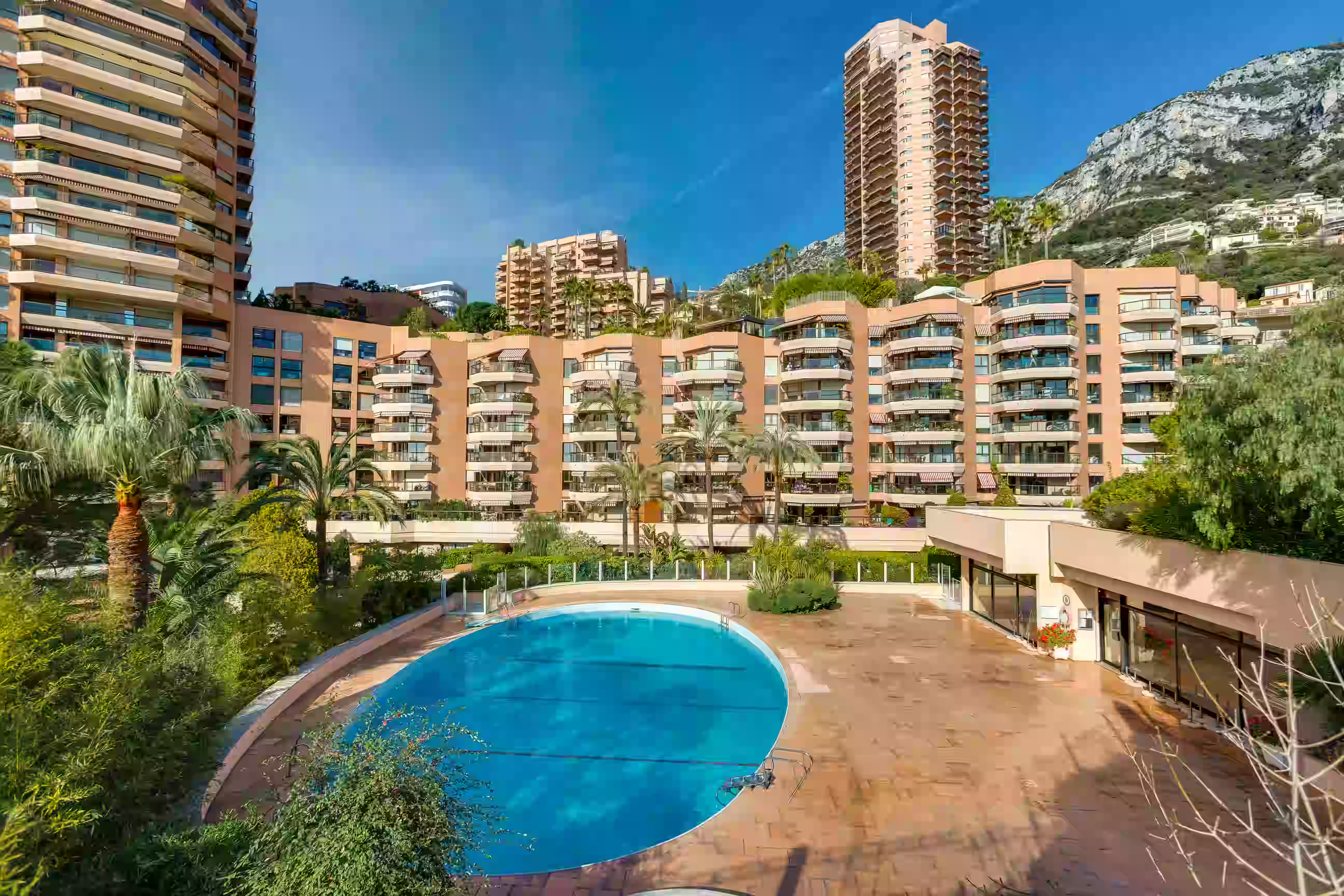
With 38,423 residents on 2.08 km², Monaco reaches around 18,500 inhabitants per km². This level stands close to the density of central Paris, around 20,000 inhabitants per km², yet applies here to an entire country. For comparison, Singapore, often cited as a dense city-state, records around 8,000 inhabitants per km².
In daily life, this density translates into vertical architecture, compact districts and a high share of apartments over houses. Villas remain rare and concentrate in a few addresses. Residents walk, use the lifts and the bus network, and park in underground car parks, as surface space is scarce.
Monegasques and foreign residents
Monegasque nationals represent 24.1% of residents, with 9,262 people living in the Principality. They form the leading group, yet three out of four residents hold a foreign nationality. In total, the 2024 census counts 145 nationalities. Monegasque nationality passes mainly through filiation, and naturalisation remains exceptional, which keeps the group stable over time.
This mix shapes daily life. French is the official language, Monegasque is the national language taught in schools, and Italian and English circulate widely in shops, schools and offices. Among adults who settled in the Principality since 2022, around 31% come from France, 15% from the United Kingdom and 9.4% from Italy, according to their geographic origin.
Age structure of the population
The average age reaches 47.3 years (46.6 for men, 47.9 for women). The 50 to 64 group leads the table, and nearly one resident in ten is over 80, which reflects both a long life expectancy and the appeal of Monaco for retirees. New residents arrive younger, with an average age of 44.6 years, and bring a steady flow of families, entrepreneurs and professionals to the Principality.
How Monaco's population has evolved over time
Monaco's resident population has almost doubled since 1951. Growth followed the land reclamation projects and the construction of new residential buildings, as each extension opened room for new housing and new residents.
- 2006: 32,543 residents (estimate)
- 2016 census: 37,308 residents
- 2024 census: 38,423 residents
- Annual change at the 2024 census: +56 residents (+0.1%)
Growth now remains modest. The housing stock sets the pace rather than demand, and the Principality welcomes new residents only as fast as homes become available. This balance between a fixed territory and a steady flow of arrivals keeps the population close to 38,000 to 39,000 people.
Residents and daytime population
The resident count tells only part of the story. On working days, the number of people present in Monaco rises well above 38,423, as a large share of private sector employees live in France or Italy and commute every day by train, bus or car.
This daytime population explains the traffic at the borders in the morning and evening, the demand for parking and the activity of the Monaco-Monte-Carlo station. It also highlights a distinction that matters for anyone planning a move: working in Monaco differs from living in Monaco, which requires a residence permit and a home in the Principality. Shops, restaurants and public services adapt to both groups, which explains the lunchtime activity around the port and the business districts.
How limited land shapes Monaco's property market
A territory of 2.08 km² and a stable population produce a direct effect on the Monaco property market: supply remains scarce and prices stay high. In 2025, IMSEE recorded 493 transactions for a total of €5.9 billion, stable compared with the previous year. The average price reached €57,569 per m², and the average resale price reached €7.6 million.
IMSEE changed its method in 2025 and now uses a regression model that includes both new builds and resales, so these figures do not compare directly with earlier resale-only editions. Our guide to the price per sqm in Monaco details these values district by district.
Larvotto is the only district above €70,000 per m², a threshold it crossed for the first time in 2025. With so little land available, every new extension and every renovated building matters, and many rare properties change hands off-market, through private networks rather than public listings.
At Balkin, our team combines local expertise since 2005 with the Knight Frank global network to give you discreet access to off-market properties in Monaco and apartments for sale in Monaco, whether you plan to buy, rent or entrust the management of your property. Read our guide to selling off-market property in Monaco to understand how this approach works, or arrange a private consultation with our advisors.


.avif)